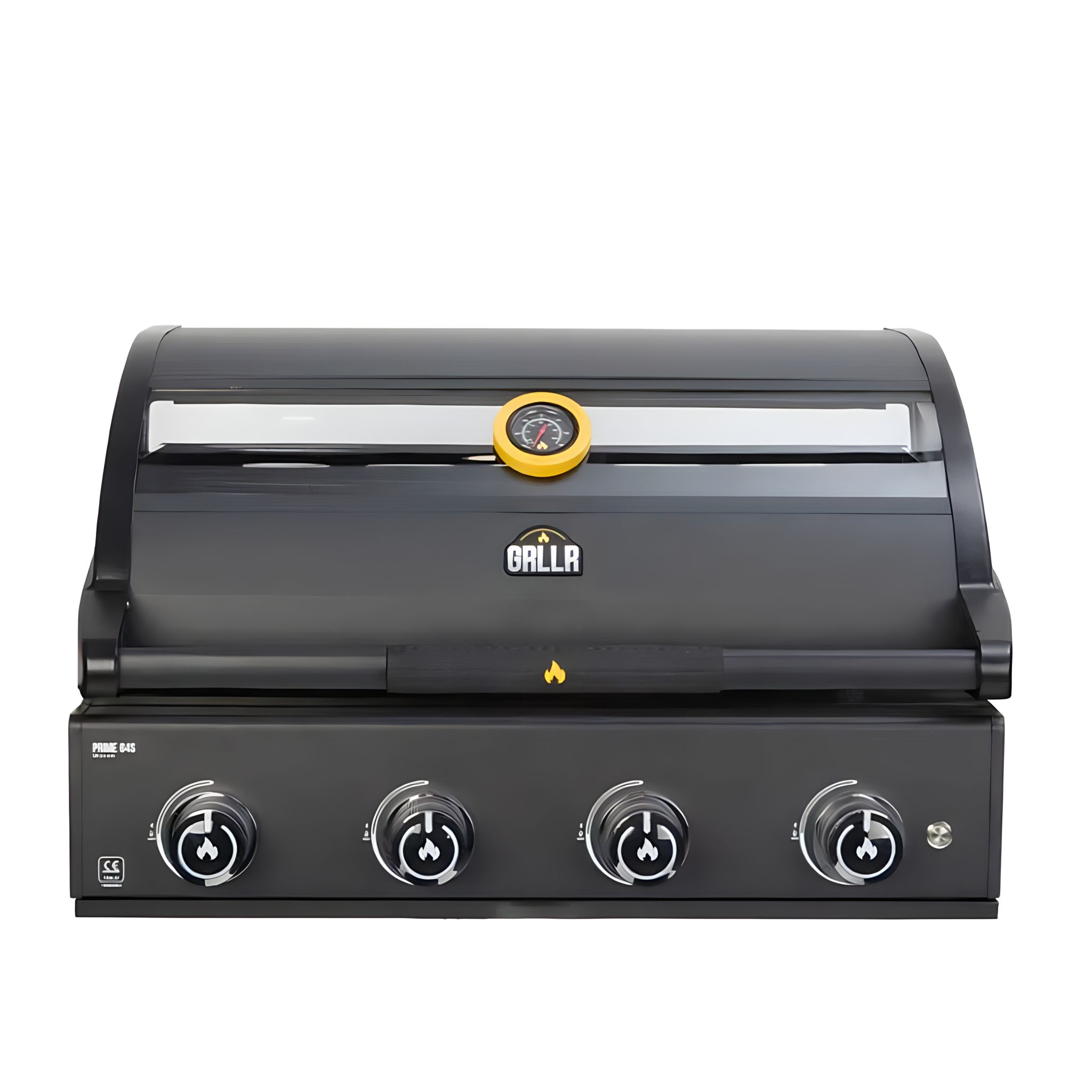
GRLLR G4 Build-In Gas Barbecue: Assembly & Operation Manual
Step-by-step guide for assembling, installing, and operating the GRLLR Prime G4 Build-In Gas Barbecue. It includes clear instructions for setup, gas connection, ignition, and maintenance to ensure safe and efficient use.
Product Information
Prime G4 Build-in
Elevate outdoor cooking with the GRLLR Prime G4 Build-in Gas Berbecue. Seamlessly integrate this 4-burner powerhouse into your outdoor kitchen for professional-grade results and unmatched grilling versatility
Insulated hood for optimal heat preservation
High-power stainless steel split tube burners
Stainless steel flame tamers/flavour bars
Grill flow system for optimal fat removal and safety. Less flare-ups and healthier food.
I3+(28-30/37) BE, CH, CY, CZ, ES, FR, GB, GR, IE, IT, LT, LU, LV, PT, SK, SI
I3B/P(30) BE, CY, DK, EE, FI, FR, GB, HU, IT, LT, NL, NO, SE, SK, RO, HR, TR, BG, IS, LU , MT, RU
I3B/P(37) PL
I3B/P(50) AT, CH, DE, SK
I2E GB, AT, AL, BG, HR, CZ, DK, FI, GR, IS, IE, IT, LV, MK, NO, PT, RO, SK, ES, SE, CH, TR
Manufacturer: The GRLLR Company B.V.
Materials
1
Flame Tamer
4 Piece(s)
2
Firebox Assembly
1 Piece(s)
3
Left Bracket
1 Piece(s)
4
Right Bracket
1 Piece(s)
5
Battery Compartment
1 Piece(s)
6
4H - Hood
1 Piece(s)
7
4R - Warm Rack
1 Piece(s)
8
4C - Cooking Grid
3 Piece(s)
9
4GC - Grease Tunnel
1 Piece(s)
10
A - M6X12
8 Piece(s)
Assembly
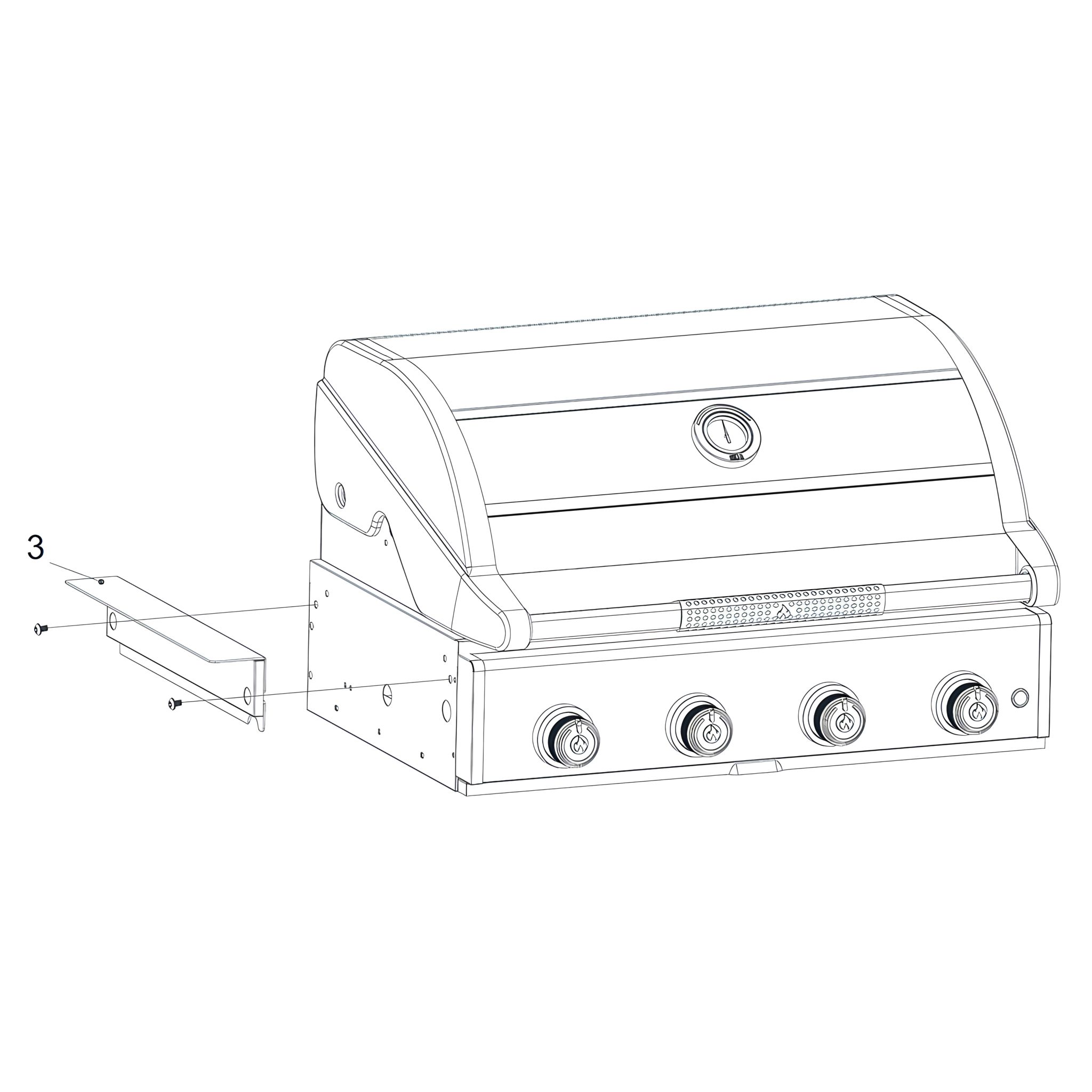
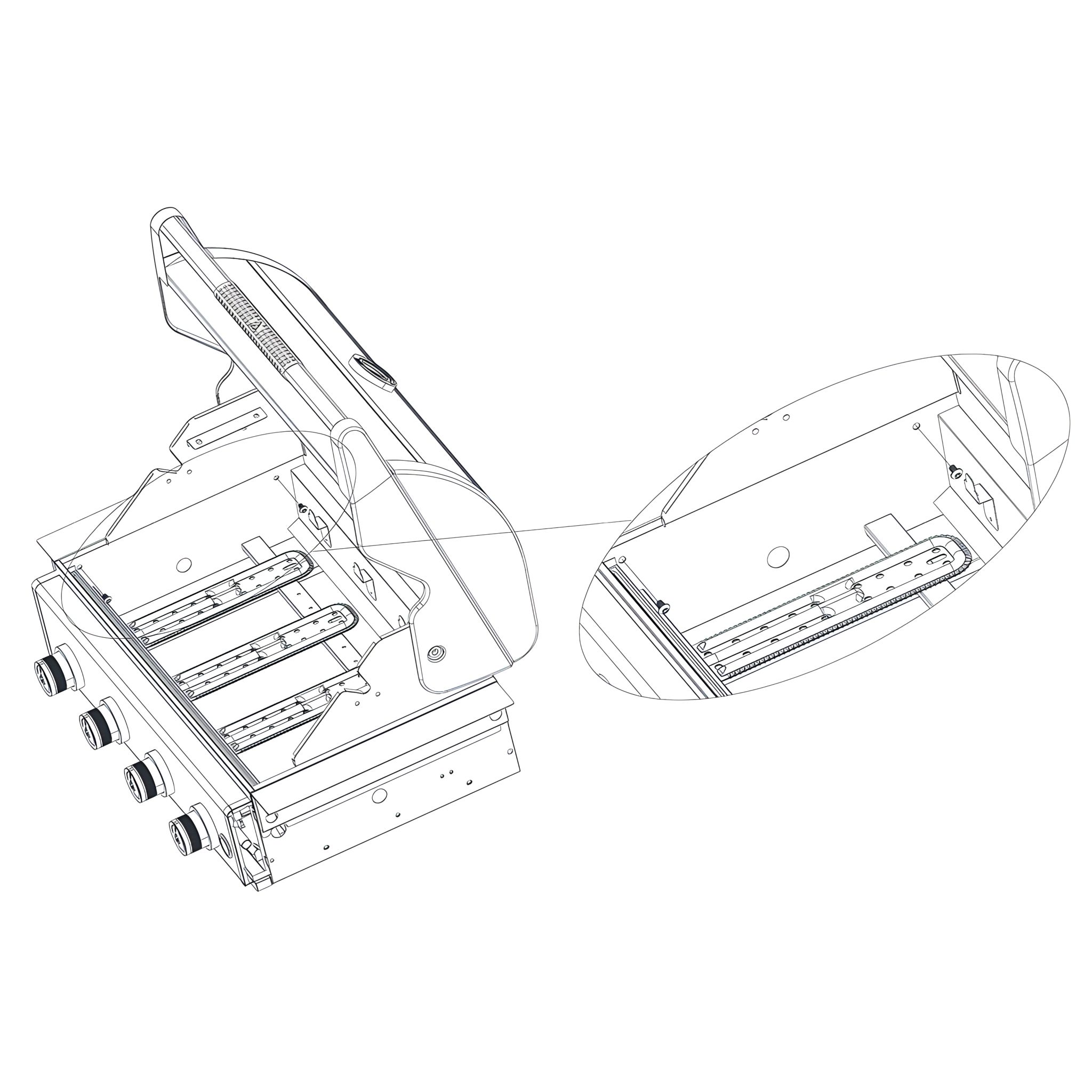
1. Attach the Left Bracket
Position the Left Bracket (3) on the left side of the Firebox Assembly (2).
Align the holes of the bracket with the side panel.
Secure the bracket using M6×12 bolts (A).
Parts used:
Firebox Assembly | 2 | 1×
Left Bracket | 3 | 1×
M6×12 Bolt | A | 2×
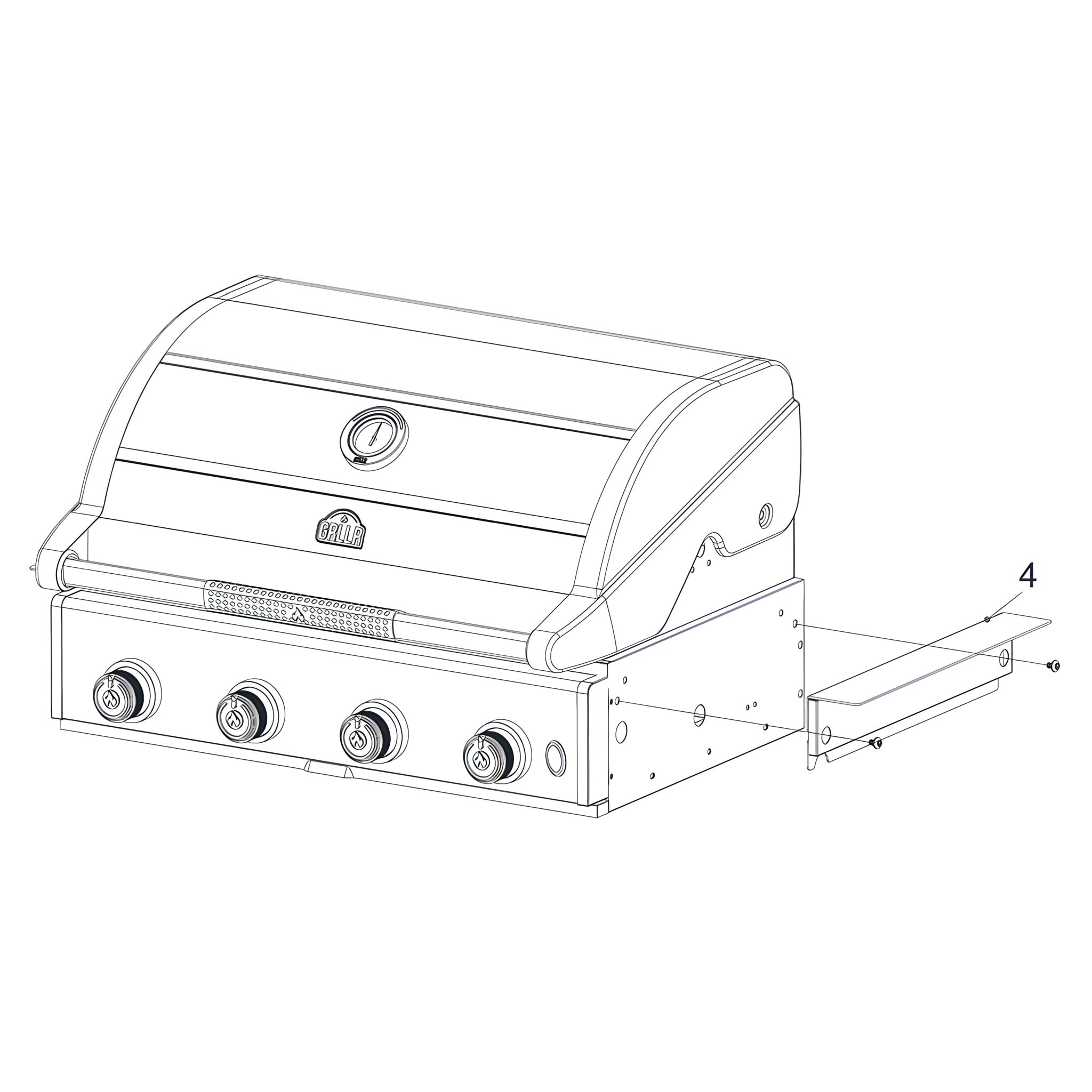
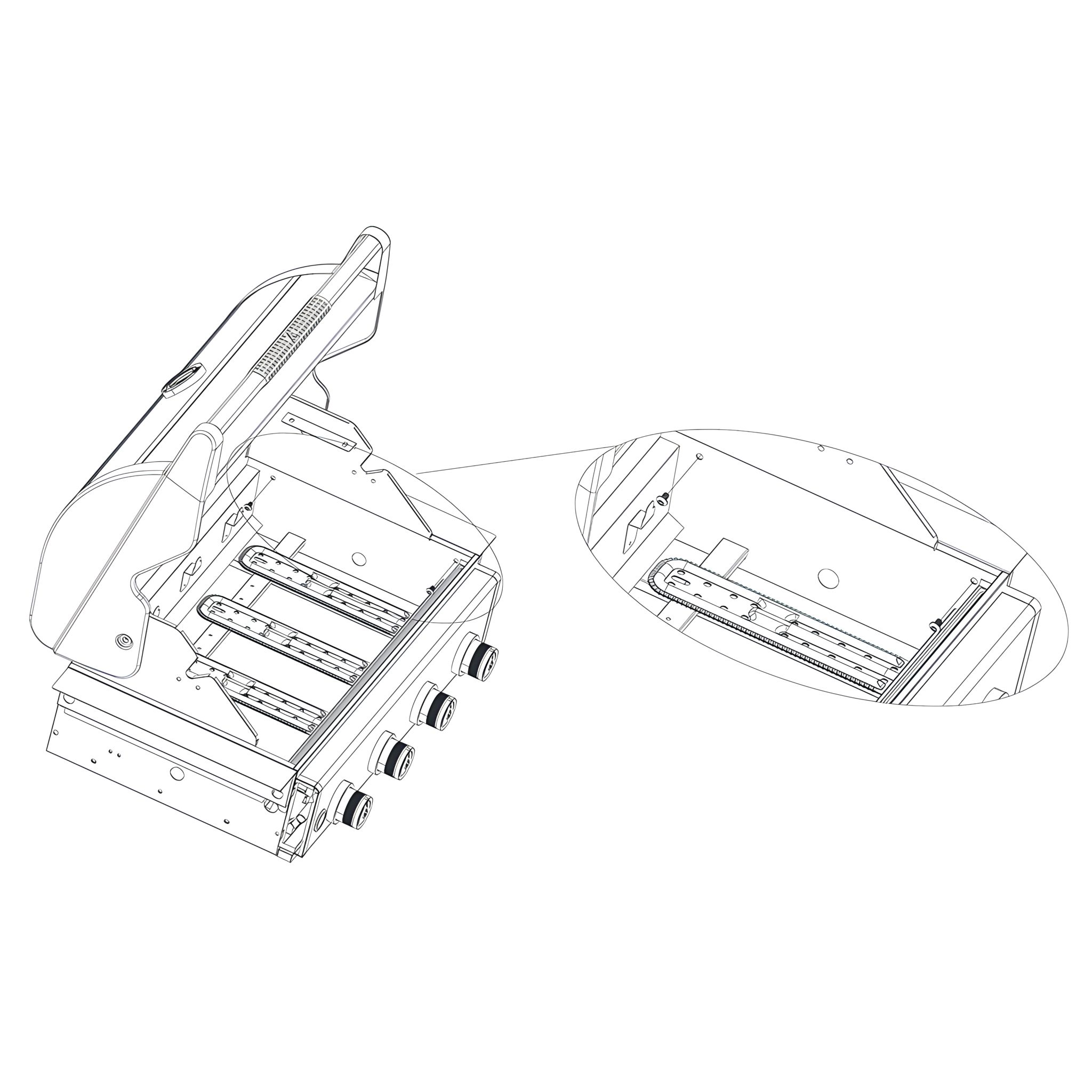
2. Attach the Right Bracket
Position the Right Bracket (4) on the right side of the Firebox Assembly (2).
Align the holes of the bracket with the side panel.
Secure the bracket using M6×12 bolts (A).
Parts used:
Firebox Assembly | 2 | 1×
Right Bracket | 4 | 1×
M6×12 Bolt | A | 2×
3. Secure the Firebox Assembly
On the inside of the firebox, align the holes as shown.
Secure the bracket with M6×12 bolts (A).
Parts used:
Firebox Assembly | 2 | 1×
M6×12 Bolt | A | 2×
4. Secure the Firebox Assembly (Other Side)
On the opposite side of the Firebox Assembly (2), align the holes as shown.
Insert and tighten M6×12 bolts (A) to secure the bracket in place.
Parts used:
Firebox Assembly | 2 | 1×
M6×12 Bolt | A | 2×
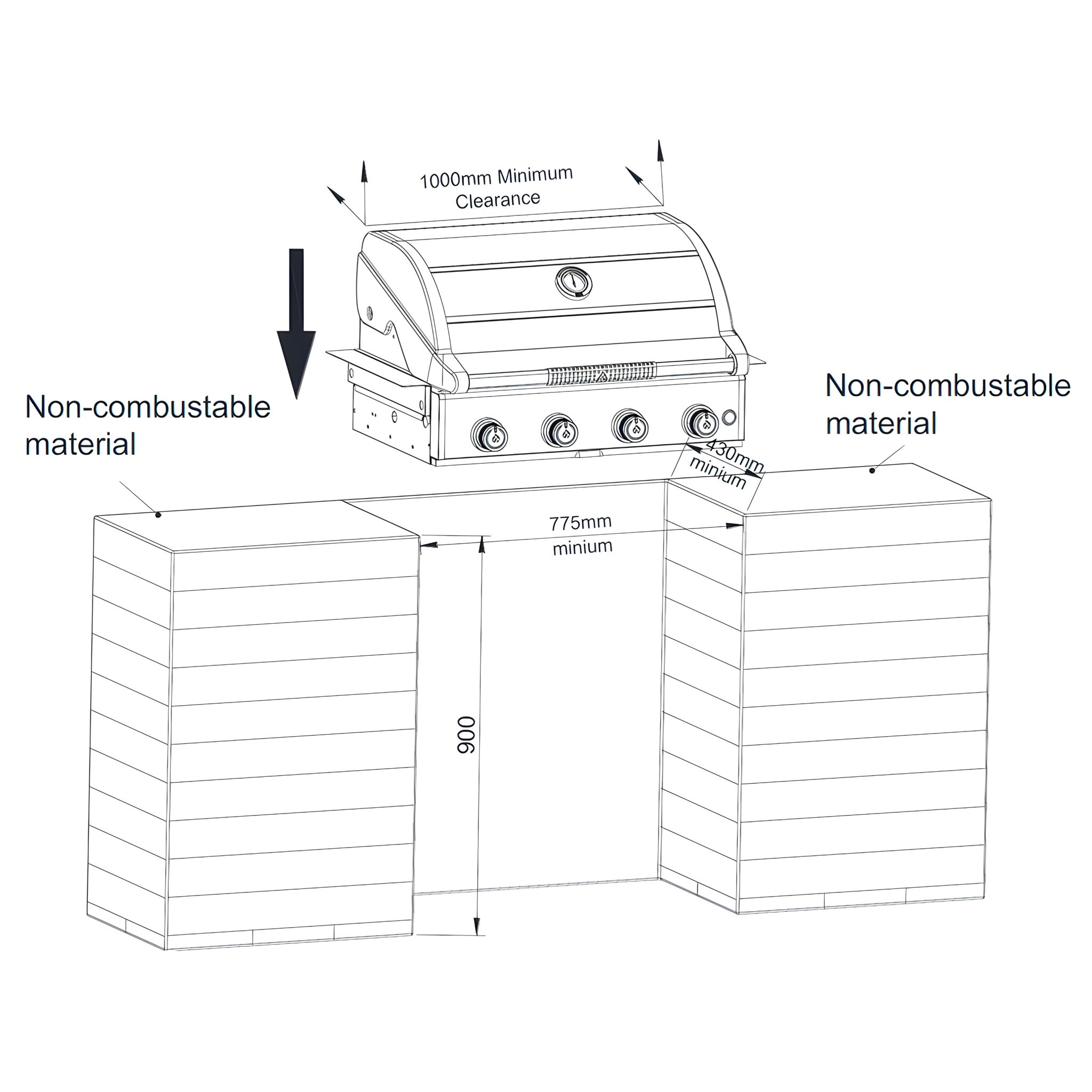
5. Install the Barbecue into the Built-In Structure
Prepare a non-combustible enclosure with the following minimum dimensions:
Height: 900 mm
Width (opening): 775 mm minimum
Depth (front to back): 430 mm minimum
Maintain a minimum clearance of 1000 mm above the barbecue.
Lower the Firebox Assembly (2) with brackets into the prepared opening.
Ensure the unit is fully supported and level.
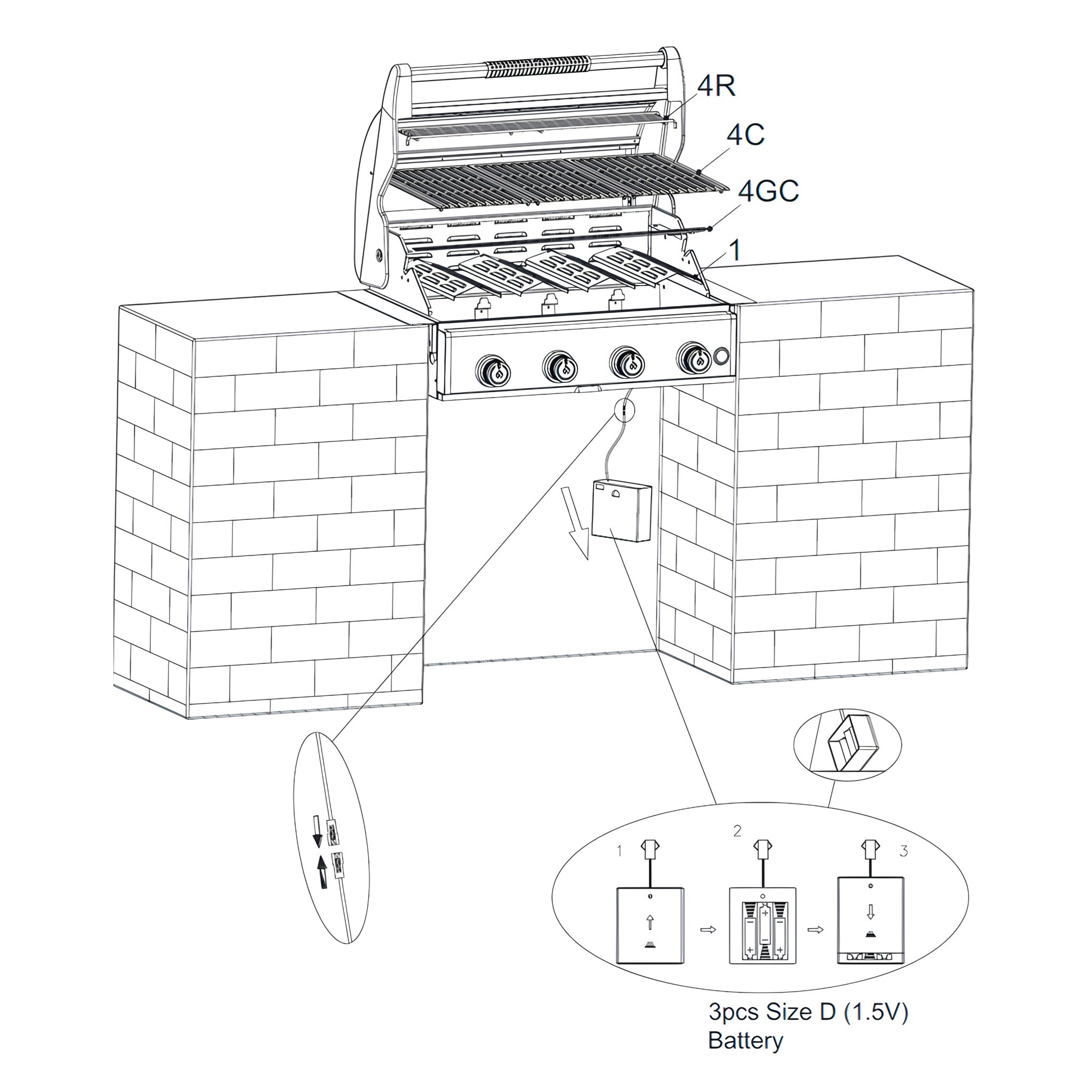
6. Install the Internal Components and Battery
Place the Flame Tamers (1) over the burners inside the Firebox Assembly (2).
Position the Grease Tunnel (4GC) in the designated slots.
Insert the Cooking Grids (4C) on top of the firebox.
Place the Warm Rack (4R) above the cooking grids.
Attach the Battery Compartment (5) to the underside of the control panel.
Insert 3 × Size D (1.5V) batteries into the battery compartment, following the polarity guide.
Parts used:
Flame Tamer | 1 | 4×
Grease Tunnel | 4GC | 1×
Cooking Grid | 4C | 3×
Warm Rack | 4R | 1×
Battery | 5 | 1×
Usage
7. Gas Connection
Connecting the LPG gas cylinder to the appliance
Use only butane, propane, or a low-pressure LPG mixture with this appliance.
Connect the gas cylinder with a suitable low-pressure regulator and a flexible hose.
Secure the hose with hose clips or screws.
Refer to the technical specifications for the correct operating gas pressure.
Use only regulators certified to EN 16129:2013 and hoses certified to EN 16436-1.
For guidance on suitable regulators and hoses, contact your LPG supplier.
8. Gas Cylinder Safety
Always change over a gas cylinder away from any possible of ignition in a well ventilated
area.
Do not smoke whilst handing the gas cylinder.
Never store gas cylinder indoors.
Store away from direct heat in a well ventilated area.
Always keep the gas cylinder in an upright position.
Close the gas cylinder valve when the appliance is not in use.
Do not subject the gas cylinder to excessive heat.
Cylinders should never be stored in temperatures in excess of 50°C. Never store gas
cylinders close to flames, burners or other heat sources.
Type of Gas Cylinder to Be Used
There are many different size of gas cylinder available. The spec of shown here is the
maximum that should be used.
Max Capacity: 11kgs
Max Height: 590mm
Max Diameter of Bottom: 305mm
9. Regulator & Hose
This item is not supplied with the barbecue but are available separately from your retailer
or approved LPG gas distributor. Use only regulators and hoses intended for use with
LPG at the pressures indicated according to correct gas pressure and gas type (Refer to
technical specification). The service life of a regulator is estimated at 10 years. It is
recommended that you change the regulator 5 years after its date of manufacture.
The hose should be changed when national regulations require. It is recommended that
you change the hose 5 years after its date of manufacture.
Using an unsuitable regulator or hose is dangerous. Ensure that the products that you
have are suitable for use with your barbecue.
The hose used must comply with the standards in force in the country of use. The hose
must be a minimum of 0.6 meter long and a maximum of 1.5 meter. A damaged
regulator or hose must be replaced. Ensure that the hose is not blocked, kinked or in
contact with any part of the barbecue other than the connection point.
10. Leak Test
Do this before using the appliance.
Do not test for gas leakage with open flame. If smells gas, turn off gas supply
immediately.
Before each use, must check for gas leakage as below procedure:
Mix one part washing up liquid to three parts water to make 60 to 90 ml of leak
finding solution.
Ensure that the control valve is closed.
Connect the regulator to the cylinder and the open/close valve to the burner. Ensure
that connections are correctly made and then open the gas inlet valve.
Spread the solution over the hose and all joins with a brush. If any bubbles appear,
then there is a leak, which must be repaired before the barbecue is used.
Test again, once the leak is repaired.
Close the gas inlet valve on the cylinder, when the test is complete.
If a leak is detected which cannot be repaired, do not attempt any other action but
contact your distributor for assistance.
11. Burning Off Factory Grease Before First Use
Measures to perform before using the product for the first time.
When burning off the storage grease, the appliance produce unpleasant
smoke.
This is normal, the smoke will vanish once the storage grease has been
burned out.
After the leak test, the grease used during factory storage must be burned off from the grill
before it can be used.
You can burn off the storage grease by following the instructions below:
Open the hood and ignite all burners according to the lighting instructions.
Set the burner to “MAX” and let them burn for 5 minutes with hood open.
Close the hood and keep the burner at “MAX” for 10 minutes
Close the regulator valve and turn off the burner.
Let the appliance cool down for 15 minutes.
Clean the cooking grids with grill-cleaning brush.
Grease the cooking grids with cooking oil.
12. Before Use
To operate the grill safely and appropriately, you need to perform a few checks before each
use.
Carefully go through the checklist below:
Check that the grill is place correctly and there are no flammable materials in the
immediate vicinity of the grill.
Check that the gas hose is not cracked or torn.
Check that the regulator is fastened tightly.
Check that the grill’s bottom, grease tray, flame tamer and burners are clean of grease
and marinade. By doing this, you can prevent grease fires.
Checked that the burner holes are not covered by insert or webs.
Checked that there are no bristles from grill brushes stuck to the grill or grids.
Lighting
13. Lighting Instructions Using the Integrated Piezo Igniter
Open the hood.
Turn on the regulator valve.
Ensure all control knobs are in the OFF position.
Push down a control knob and turn it anti-clockwise to the ignition position, this will light the burners.
Once the first burner is lit, repeat for the others.
Adjust flame intensity between MAX and MIN.
If ignition fails, turn knob to OFF, wait 5 minutes, and try again. If you cannot get the burner to ignote using the pienzo igniter, you can try lighting the burner up with a long match or lighter.
To turn off: close the gas cylinder valve (or regulator switch), then turn all control knobs to OFF.
14. Igniting with a Long Match or Lighter
Open the hood of the grill.
Turn the regulator valve on.
Light a long match (min. 90mm length) or lighter.
Push down the control knob and turn it anti-clockwise to the “MAX” position.
Place a long match or lighter about centimeter away from the burner.
When the first burner has been ignited, you can ignite the remaining burners in order by
turning
the control knob counter-clockwise between
When the first burner has been ignited, you can ignite the remaining burners in order by
turning the control knob anti-clockwise between “MAX” and “MIN”.
If the burner does not light up within five seconds, turn the control knob to OFF and
try
to find a solution from the troubleshooting table. Or contact your retailer/distributor.
15. Checking the Flames
Always check the flame when turning the grill on. The burners have been optimized at the
factory, but the small holes on them attract insects to nest and make webs on the burners.
When the burners are burning properly, only the tip of the flame is occasionally yellow and
the flame’s color changes from light blue to dark blue from the top down.
Maintenance and Care
16. Preventing Rust
Rust is a chemical process in which iron oxidizes and begins to flake away the metal. This is
cause by water that soaks into the metal or comes in contact with the metal frequently over
time. As an outdoor appliance made of steel, some appearance of surface rust should be
expected from time to time.
Keeping your grill under cover, clean and dry, goes a long way
to preventing rust occurring, some tips are:
Ensure cooking surface (including flame tamer) are kept clean and dry after cooking,
particularly after cooking with marinades. Cooking surface should be rubbed with oil after
use.
Do not leave the grill out in the rain.
Do not store the grill when wet. Dry thoroughly first.
During both summer and winter, periodically remove the cover to enable the grill to air
out, and get rid of any built up condensation.
Light surface rust may be easily removed with rag, soaked in white vinegar, or using a
commercial rust remover. Dry the affected area and apply a coating of rust preventing
fluid, available at most auto stores.
Chipped enamel can be treated with touch up paint to cover the bare metal surface.
17. Cleaning Cooking Grids
Do not use a steel brush intended for welding to clean the grill, as it may damage the grill’s surfaces. The warranty does not cover damage caused by such a steel brush.
If food or marinade is stuck on the grill or grid, do the following:
Check that the grill is turned off.
Remove loose food and grease from the surfaces using paper towels, for example.
Ignite the grill as instructed and set the burners to “MAX”
Close the hood and let the grill heat up for 5–10 minutes
Turn off the grill and open the hood let the grill cool down 10 minutes.
Brush burned food and dirt off with a cleansing brush intended for grills
Grease the cleaned grilling grids with cooking oil using e.g., paper towels or a cooking
brush.
18. Cleaning Grease Tray
You can make the cleaning easier by using a foil on top of the grease tray to collect
any
extra food and grease.
When cleaning the tray, you only need to remove the dirty foil.
An unclean grease tray is the most common cause of grease fires.
The grease tray must not have pools of grease on
it.
If you see pieces of food or marinade on the grease tray or cup, you must clean the tray/cup immediately by following the instructions below:
Check that the grill is turned off.
Take the grease tray/cup out of the grill.
Scrape loose food and grease off using the scraper on the grill-cleaning brush or a plastic
spatula.
Wash the grease tray/cup with mild dishwashing liquid.
Dry the grease tray/cup and place it back into the grill.
19. Cleaning Flame Tamers
The flame tamers spread the heat evenly on the grilling surface.
The surface of the flame
tamers also collects food scraps and marinade.
Dirty flame tamers decrease the grill’s
efficiency.
Clean the flame tamers by following the instructions below:
Check that the grill is turned off.
Remove the flame tamers from the grill.
Scrape food off the tamers´ surface using the scraper part of the cleaning brush or a plastic
spatula.
Finally, brush off the dirt using a brass cleaning brush intended for grills.
If you wish, you can also wash the flame tamers in a sink using mild dishwashing liquid.
Dry the flame tamers and place them back into the grill.
20. Cleaning Burner
The grill’s burners are the most vital part for the grill’s functionality and heating.
This
is why you need to check their cleanliness and condition regularly. You must remove
and check the burners at least twice a year, particularly when the grill has been in
storage for a long
time.
The small holes on the burners attract insects and spiders to nest in the
burners. Such obstructions cause the flame to burn unevenly and impurely.
Obstructions
may cause the flame to flare up outside the gas pipe, which will damage the grill
severely.
Clean the burners by following the instructions below:
Check that the grill is turned off.
Remove the grill grids and heat distributor plates.
Remove the burner from the fire box by loosening the mounting screw. The screw is
normally
located at the back end of the burners.
In some grill models, removing the burners requires that you also remove the back plates
of
the grill.
Some models can also be cleaned even when the burners are in place. The most
important
part is being able to access all of the small gas holes.
Use the brass cleaning brush intended for grills to clean the burner surfaces.
Ensure that the burner holes are open and clean. You can use a thin wire for this.
If the burner is damaged or badly corroded, replace it immediately.
At the same time, check that the valve nozzle is clean and intact.
Place the cleaned burners back into the grill.
21. Cleaning Other Grill Components
Chloride and salt may cause the grill to rust.
If the grill is being used in the immediate
vicinity of seawater or a pool, the grill must be cleaned after every use.
In addition to the components mentioned above, the grill also has many other steel parts that
need to be cleaned regularly.
You can follow the general instructions below for cleaning such components:
Clean the steel parts of the grill with grill cleaning fluid, stainless steel cleaning liquid or
mild dishwashing liquid and a cloth.
Do not forget to dry the cleaned parts carefully.
Do not use detergents for cleaning the control panels and the surfaces with warning
labels, as
they may remove the text or other labels.
Clean all of the grill’s outer surfaces at least three times a year so that stains do not stick
to the
surfaces.
Always test the suitability of a new detergent on an unnoticeable spot.
22. Storage
Check these instructions if you stop using the grill for a longer time or you wish to put the grill
into storage for the winter, for example.
Proper storage prolongs the grill’s service life and
keeps it operational for many years.
When storing the grill, follow the instructions below:
Clean the grill completely according to the instructions in the manual.
Turn the grill on and let it warm up for 15 minutes so that all steel parts dry off.
Let the grill cool down.
Ensure that all grill grids are greased.
If storing the grill outdoors, remove the burners, grids, heating grid and heat distributor
plates
from the grill. These parts need to be stored in a dry and warm space. It is also
recommended
that you wrap these parts into newspapers or similar so that the surfaces do not get
scratched.
Remove the low-pressure regulator from the gas cylinder.
Always store the gas cylinder outdoors and ensure that it is not exposed to heat or
sunlight.
If the grill is stored outdoors, it is recommended that you purchase a high-quality cover for
it that
covers it all the way down. Ensure that air can circulate even under the cover.
Troubleshooting
23. Handling Malfunctions
Malfunctions may occur in all grills. These malfunctions are usually easily fixable. If you
cannot find a solution for your problem in the table below, please contact the retailer or
distributor.
24. No gas flow
Regulator valve is off
Turn the regulator valve on
The regulator is not connect to the gas cylinder properly
Remove the regulator and connect again
The regulator and hose are faulty
Replace the new regulator and hose
25. The burner can not ignite with Integrated push-turn piezo
The igniter cables are loose or incorrectly installed (For side burner)
Check the connections and re-install the cables
The faulty assemble of valve
Adjust the ignitor to the burner
26. The burner can not ignite with match or lighter
The burner’s holes are blocked
Clean the burners according to instructions
The burners are not properly attached to the valves
Check the installation and condition of the burners
27. Not heat up properly
The air supply into the burners is blocked
Check and clean the burners
Too little gas
Replace the full cylinder
Regulator is obstructed
Check that the gas hose is intact and not twisted
28. The flame is uneven, completely yellow or smoking
The burners do not get sufficient air
Clean the burners according to instructions
There is food, salt or marinade stuck on the burner surface
Clean the burners according to instructions
29. The flame flares up often or the temperature is too high
Too much grease and marinade on the food
Wipe any extra grease off
The flame tamer or grease tray are too dirty
Clean flame tamer or the grease tray of excessive food or grease
30. The flame does not stay on
The wind is too strong
Move the grill away from wind
Low gas
Replace the full cylinder
31. Flames are visible outside the burners
Obstruction in the burners
Check and clean the burners